F. Scott Fitzgerald
I cannot precisely recall the moment I first decided to pick up this book. Perhaps I was driven by my urge to enter the rampant cynicism and alcoholism of the Jazz Age—prominent in all of Fitzgerald’s work. Or maybe, like all other pretentious literary nerds out there, I believed it held some kernel of immense wisdom that had previously escaped my grasp.
Or maybe it was simply because I was dying to read Fitzgerald. Perhaps, after finishing The Great Gatsby, I had been starved of his nihilistic prose; his gripe being the hedonism of America and the disillusionment of the masses.
Needless to say, this book has not disappointed (I am still in the process of reading it). Fitzgerald continues to propagate his themes of nihilism and overconsumption, aptly portraying the dichotomy between the new and old during the Jazz Age.
I find myself eagerly turning the page, just to see how the main character, Anthony, fares in the next chapter, awaiting the sudden tragedy that is to befall him. It’s often beyond me to pray for the ruin of the so-called protagonist, but Fitzgerald’s writing makes it increasingly difficult to root for the main character. While reading this, I feel like a silent observer watching Anthony interact with his wife and friends, and awaiting the disaster I know will unfold from beneath his feet.
Overindulging in their material life (despite their lack of financial wellbeing), the couple is continuously inebriated, helplessly bored, and unemployed (which obviously leaves no time for them to face their deep- seated depression, and internal emptiness). While reading, I feel entirely unsympathetic to the blindness and complacency of these characters; I am only frustrated, as they seem beyond the point of bettering themselves.
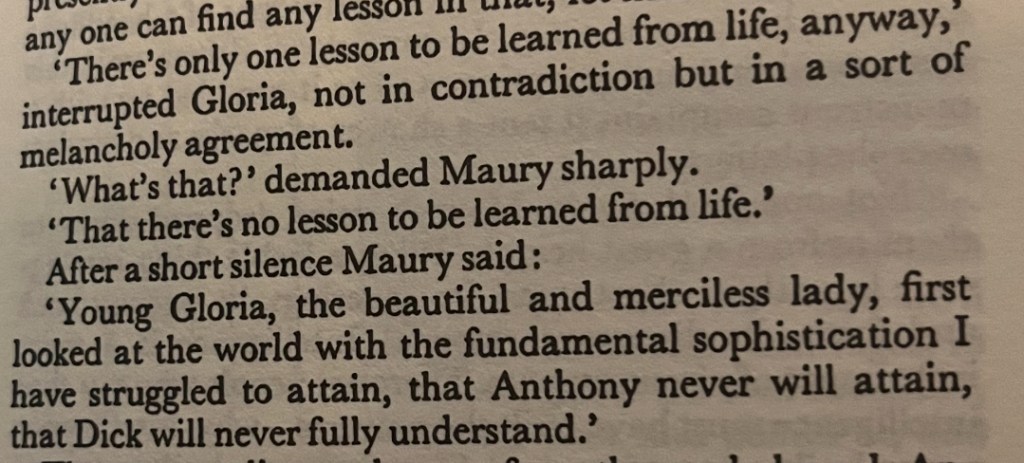
The pull between the new and the old is central to the plot of this book and to Fitzgerald’s ideas surrounding the American Dream. The quote featured above is one that I came upon in my reading that summed up the nihilistic philosophy of Anthony and his wife, Gloria. When I read it, a mixture of both laughter and curious surprise overtook me—I wanted to understand it further.
“‘There is no lesson to be learned from life,'” Gloria argues. Her words are indicative of her (and her husband’s) hedonistic lifestyle, which proves to be their one fatal flaw. In truth, none of the material pleasures of life (i.e alcohol, women/men, money) will fill their internal void. No matter how much they distract themselves, they cannot run from their own humanity.
The tragedy of this book is truly Anthony and Gloria’s inability to awaken to their predicament. They must awaken in order to save themselves, but at the same time, there is an underlying resistance. They both fear the upheaval of their current reality, as they will have to face their true selves and acknowledge just how beyond repair they truly are.
In a world revolves around consumerism, whether visually (online) or physically, Fitzgerald’s The Beautiful & Damned is still a highly relevant piece of literature that will undoubtedly survive the test of time. It encourages us all to face our own humanity and warns against the dangers of distraction and overconsumption. I highly recommend this book to anybody who enjoyed The Great Gatsby; it is equally as enlightening, entertaining, and powerful.
 Spilled Ink